
The cost of a Michigan public university education as a percent of family income continues to fall dramatically
The cost of a Michigan public university education as a percent of family income continues to fall dramatically
A little over two years ago, I wrote in this space how Michigan’s public universities are much more affordable than many people think. We’ve all heard some of the horror stories from students who attended for-profit colleges or expensive online private school master’s programs who in turn were saddled with mountains of debt without reaping the increased earnings capacity that the credentials were supposed to generate. Not so is the case as it involves Michigan’s public universities. But in reality? Michigan public university students and their families are paying less out of pocket than 15 years ago.
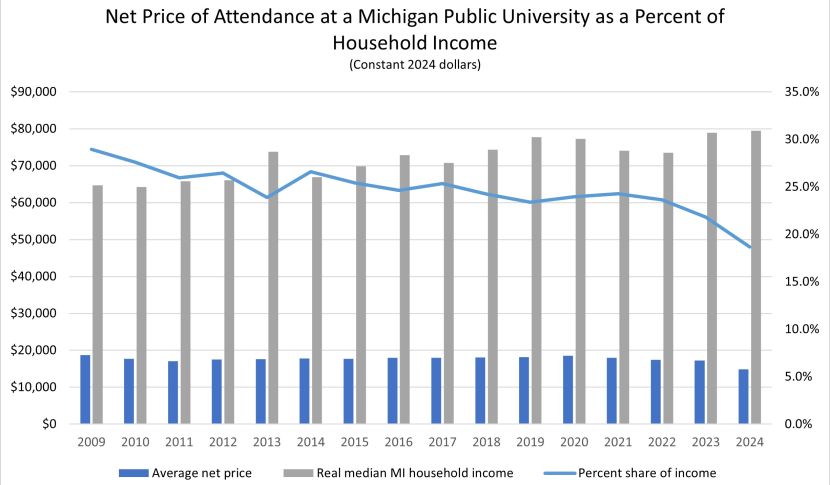
When we talk about the true cost to students and families, it’s important to look at the overall buying power of a family’s income. However much tuition costs, it’s essentially an arbitrary figure unless we know what a dollar is worth or how much money the average Michigan family has. Here’s the good news: just as was the case in my post two years ago, the chart above shows that a Michigan public university education is much more affordable than it was years ago thanks to universities’ cost containment efforts, the growth of household income, and substantial additional investments by the state and the institutions in student financial aid.
First of all, the overall average net price of attending a public university is decreasing by itself, going from $18,733 in 2009 to $14,825 in 2024 (all dollars constant in 2024 figures). Even that cost decrease alone is notable! But when you compare that net price against the rising median household income, you can see that families have had more income to buy goods and services. The same university education that cost 28.9% of family annual income in 2009 cost only 18.7% of family income in 2024! What happens when the cost of a Michigan public university education is falling over time while income is rising? That’s a recipe for better affordability that will make a college investment an even wiser decision.
What drives these factors? By and large, the universities and their dedication to keeping tuition increases to the absolute minimum needed is one of the biggest factors, as well as the $1.6 billion that the universities contribute in institutional financial aid each year to students. That’s $1.6 billion directly to students, $1.6 billion as a choice to invest in students for which the universities often don’t get recognition. That’s a great deal of money that has been making an education possible for Michigan students while the state mostly stopped funding students over the same period of time that the chart above examines.
Related though, the other factor driving the dropping cost is the state’s turnaround in student financial aid, namely the much appreciated recent creation and investment in the Michigan Achievement Scholarship (MAS). University affordability is a direct result of the state’s investment in its public universities and their students, and the substantial investment by these institutions in financial aid to students. Thanks to the MAS and the $5,500 per year it can provide to university students, the state has finally started providing student aid again like almost every other state does, but which Michigan abandoned in the tough years of 2009 and 2010.
The MAS combined with university efficiency, institutional financial aid investments, and rising incomes? That’s how students across Michigan from Ironwood to Detroit can afford a high quality education for far less expense than is commonly believed.
Mia Murphy is the Chief Policy Officer at the Michigan Association of State Universities.