Supporting Higher Education in Michigan Through the School Aid Fund: A Constitutional, Strategic and Fiscally Responsible Approach

Supporting Higher Education in Michigan Through the School Aid Fund: A Constitutional, Strategic and Fiscally Responsible Approach
Using School Aid Fund (SAF) dollars to support Michigan’s public universities and community colleges is a constitutional mandate and is historically grounded. It is fiscally responsible and strategically aligned with Michigan’s long-term educational and workforce goals.
Constitutional and Consistent with Voter Intent
Michigan’s Constitution (Article IX, Section 11) clearly states that the School Aid Fund shall be used exclusively for “aid to school districts, higher education, and school employees’ retirement systems, as provided by law.” The inclusion of “higher education” dates back to the 1963 Constitution and was retained during the sweeping reforms of Proposal A in 1994.
The SAF-General Fund Relationship is a Two-Way Street
Public debate often characterizes SAF support for higher education as a “raid” on K–12 funding. However, a recent Citizens Research Council report demonstrates that the relationship between the SAF and the General Fund (GF) is far more complex and reciprocal. In fact, for all practical purposes, GF dollars “hold harmless” the SAF.
Multiple tax policy changes over the past two decades have required the General Fund to absorb revenue losses that otherwise would have reduced SAF resources. These include income tax earmark adjustments, sales tax exemptions, and personal property tax reimbursements. Collectively, these “hold harmless” provisions are estimated to total approximately $740 million in FY2026 and nearly $900 million in FY2027.
Notably, the FY2027 estimate approaches 70 percent of the total $1.3 billion SAF appropriation that is currently being allocated for higher education purposes (community colleges and public universities). In other words, while SAF dollars support higher education, substantial GF dollars simultaneously protect and supplement the SAF. This is a balanced fiscal relationship, not a one-way transfer.
SAF Support for Higher Education is Longstanding and Bipartisan
SAF dollars have supported higher education since FY2010, with the first SAF appropriation for community colleges. SAF support expanded to public universities in FY2012 during a major GF structural deficit. Since FY2019, the entire community college budget has been funded through the SAF. Today, 100% of community college funding and more than one-third of public university funding comes from the SAF.
These decisions have occurred under both Democratic and Republican governors and legislatures. The use of SAF dollars for higher education is no longer temporary; it is a structural feature of Michigan’s modern budget architecture.
Michigan’s Education System is a Continuum
Michigan’s educational ecosystem is interconnected. Students move from K–12 to community colleges and universities as part of a single pipeline. The Constitution recognizes this continuum by authorizing SAF support for both K–12 and higher education. The SAF has supported multiple components of the state’s education system, reflecting the importance of a strong, connected education pipeline. Investing SAF dollars across the full spectrum of education in Michigan strengthens workforce development, improves college affordability and degree attainment, enhances economic competitiveness, and retains and attracts employers.
A Smart Strategy in a Constrained Budget Environment
Michigan faces significant General Fund pressures in FY2027, including downward revenue revisions, the fiscal impact of a $2 billion transportation package passed last year, and changes in federal healthcare and other safety net programs. State experts project a nearly $800 million GF gap between baseline spending and ongoing revenues.
Because many of these pressures fall on the General Fund, responsible use of SAF dollars for constitutionally-permitted education purposes helps protect K–12 funding, preserve higher education affordability, free up GF dollars for other state priorities, and maintain balanced budgets. The SAF remains healthy, and modest revenue growth is projected, while GF revenues are expected to decline. Policymakers must use all constitutionally appropriate tools to navigate this environment.
Total Combined Share of SAF and GF Appropriations: K-12 Schools, Community Colleges, and Public Universities
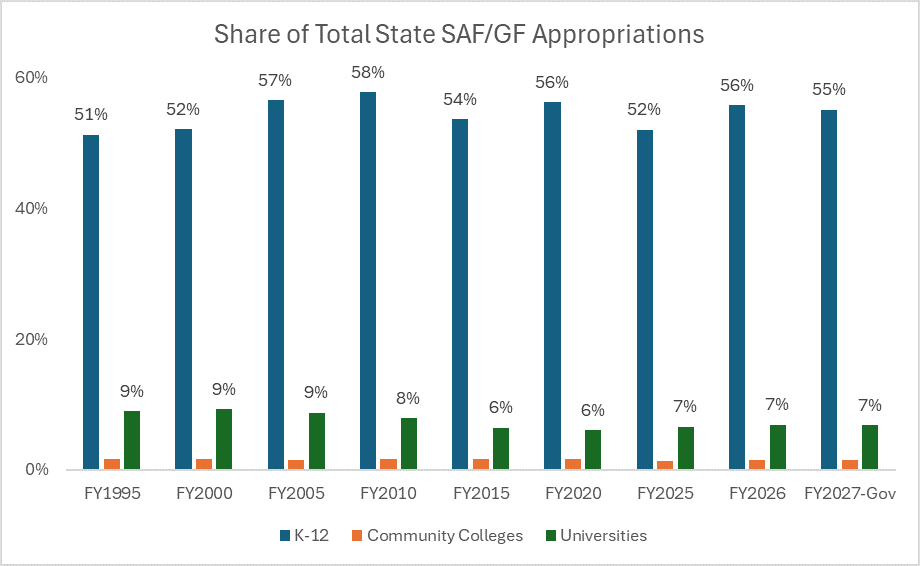
Source: Citizens Research Council; calculations based on state fiscal reports
In addition, utilizing SAF dollars to support state financial aid programs that improve affordability and access to higher education for students and families is a smart strategy. Given the very high demand for workers with bachelor’s degrees and above, and the associated ability for the state to retain and attract employers, it is more important than ever to ensure that a four-year degree at a Michigan public university remains affordable.
State Investment Drives Economic Impact
It is also important to note that Michigan’s investment in our state’s public universities through the SAF pays significant dividends for the state economy and finances. According to a recent analysis by the Anderson Economic Group, Michigan’s 15 public universities generate nearly $45 billion in net new economic activity each year – a 28x return on the state’s $1.6 billion annual appropriation – support more than 129,000 direct and indirect jobs, and return over $7 billion in annual tax revenues to the state.
Using the School Aid Fund to support higher education is constitutional, historically grounded, bipartisan, fiscally balanced and strategically aligned with Michigan’s workforce needs. The SAF/GF relationship is a two-way street. A full understanding of that fiscal interplay strengthens rather than weakens the case for continued SAF support of higher education. Michigan’s goal should be maximizing educational opportunity at every stage, and in so doing, advancing educational attainment and economic prosperity that benefits all Michiganders.
Daniel Hurley is the CEO of the Michigan Association of State Universities